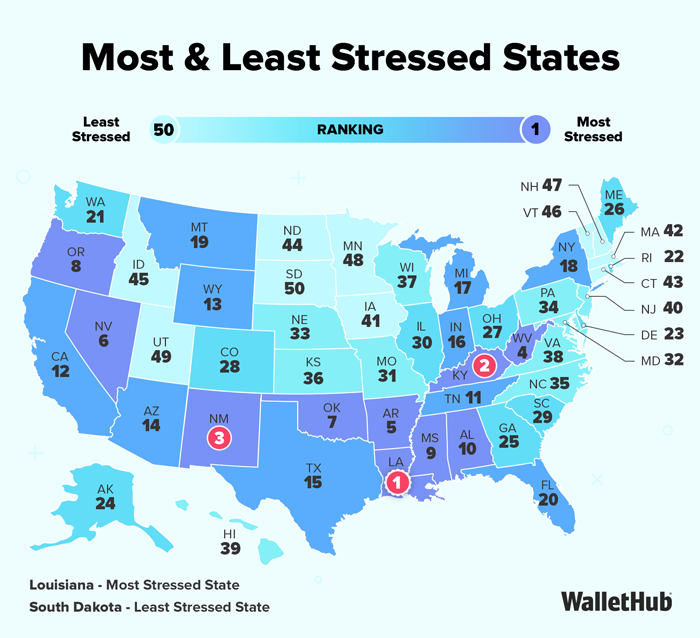
With April being Stress Awareness Month and the future of the nation, the economy and work (for those employed) proving to be Americans’ biggest stressors last year, the personal-finance company WalletHub on March 23 released its report on 2026’s Most & Least Stressed States, as well as expert commentary, to identify where Americans can best take care of their mental health and which states are in need of improvement.
WalletHub compared the 50 states across 40 key metrics. The data set ranges from average hours worked per week to the personal bankruptcy rate to the share of adults getting adequate sleep.
Stress Levels in California (1=Most Stressed, 25=Avg.):
Overall Rank: 12th
44th – Avg. Hours Worked per Week
31st – Share of Adults Getting Adequate Sleep
10th – Percentage of Adults in Fair/Poor Health
8th – Job Security
24th – Median Credit Score
1st – Housing Affordability
22nd – Percentage of Population Living in Poverty
42nd – Divorce Rate
7th – Crime Rate per Capita
43rd – Psychologists per Capita
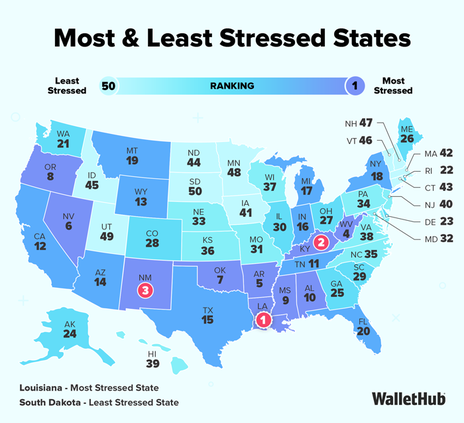
Coming in at number one, for the most stressed state, was Louisiana, followed by Kentucky, New Mexico, West Virginia and Arkansas rounding out the top five.
On the other end of the spectrum, the least stressed states were Vermont, at number 46, followed by New Hampshire, Minnesota, Utah and South Dakota at number 50, the least stressed state.
For the full report visit:
https://wallethub.com/edu/most-stressed-states/32218
“There are plenty of small ways for people to manage stress, from staying active and participating in hobbies to taking vacations from work and getting help from a mental health professional. What many people don’t realize, though, is that changing location can also be a big stress reducer. For example, states that have lower crime rates, better health care and better economies tend to have much less stressed residents,” Chip Lupo, WalletHub Analyst, explained. “Louisiana ranks as the most stressed state, in large part because it has the highest poverty rate in the country. It also ranks among the 10 worst states for both the share of adults reporting poor mental health and the share of adults diagnosed with depression. Residents may also find it difficult to find someone to address mental health issues, since Louisiana has fewer psychologists per capita than most other states.”
Expert Commentary
What tips do you have for fighting stress without spending money?
“Finding stress relief without spending money is often about tapping into free biological resets. For instance, practicing rhythmic breathing or vocal toning costs nothing but can physically lower your heart rate in seconds. Nature is another powerful pharmacy, as research shows that just 20 minutes in a park or near water can significantly lower cortisol levels. Simple habits like taking a digital detox hour can lower anxiety by reducing the sensory overload that keeps our brains on high alert. A simple, fun fact is that chewing sugar-free gum has been shown to reduce anxiety and lower cortisol levels by improving blood flow to the brain. You can reset your nervous system for free by using deep breathing, spending time in nature, or simply unplugging from your devices.”
Andrew Burnstine, Ph.D. – Associate Professor, Lynn University
“Find things that are free or inexpensive that genuinely make you happy and help relieve stress. Exercise, get out in nature, or go for a walk with friends. You can also join groups that focus on activities that do not require spending money regularly, such as a local sports league, volunteer organization, or community theatre. Local libraries may also offer a fun option. Borrow a book from your local library, or check out the online resources many libraries now offer. Even if the library is not nearby, you often do not need to physically go in to access e-books, audiobooks, and other materials. Additionally, many libraries have free programming for a variety of interests and now lend additional items such as tools and equipment for hobbies. It is also important to prioritize sleep and be mindful of caffeine intake, since too much caffeine can aggravate stress. Social media can be particularly problematic because it encourages comparison. Instead of watching other people do fun things, focus on finding ways to do things you enjoy yourself.”
Christian P. Neuman – Assistant Professor, Georgia Southern University
What can people do to address the financial stress caused by the current economic environment?
“Macroeconomic conditions, including interest rates, inflation, labor market volatility, are entirely beyond individual control. Therefore, the appropriate response is adaptation rather than reaction … Diversifying income streams, building transferable skills, and maintaining professional networks act as excellent risk-hedging strategies. When inflation is high, nominal figures can be misleading. Budgeting in terms of purchasing power (inflation-adjusted metrics) clarifies your true trade-offs. Behavioral research shows that economic downturns often trigger myopic choices, such as liquidating long-term investments or taking on high-interest debt. Maintaining a long-term perspective is critical … Investing time in skills that improve your labor market resilience generally yields much higher returns than attempting to time financial markets. At the individual level, from an economic standpoint, stress frequently arises from uncertainty and a lack of clarity ahead. Strategies that increase predictability, build buffers, and strengthen both human and social capital tend to deliver the highest returns, both financially and psychologically.”
Dr. Haiyong Liu – Professor, Texas State University
What tips do you have for parents trying to minimize their children’s stress levels?
“Parents looking to minimize their children’s stress levels should focus on the emotional climate of the home. Because kids are emotional barometers, one of the most effective tools is modeling out loud, where you narrate your own healthy coping strategies so they can learn by example. Creating a predictable routine is also vital, especially because it provides a rhythm that lets kids know there are things they can count on. A simple hug or cuddling a pet releases oxytocin, providing an instant biological buffer for both the parent and the child. It is also helpful to encourage them to take breaks from stress through play or art, which prompts positive emotions that offset anxiety. Children feel more secure when parents model healthy stress management and maintain a consistent, predictable daily routine.”
Andrew Burnstine, Ph.D. – Associate Professor, Lynn University
“One important step is limiting time on social media and encouraging kids to spend more time in the real world. Many governments around the world are currently exploring or implementing restrictions on social media use among children because of growing concerns about its impact on mental health. Comparison is often described as the thief of joy, and social media is full of opportunities for comparison. Kids are constantly exposed to images of people who appear smarter, more attractive, more accomplished, or simply having more fun than they are. Whether those portrayals are realistic or not, the comparisons can still feel very real. Encourage children to spend time with peers in person and participate in activities such as sports or clubs. Physical activity is especially helpful because exercise releases endorphins and improves mood. At the same time, it is important to maintain balance. Activities can be beneficial, but overscheduling children can create additional pressure and lead to burnout.”
Christian P. Neuman – Assistant Professor, Georgia Southern University