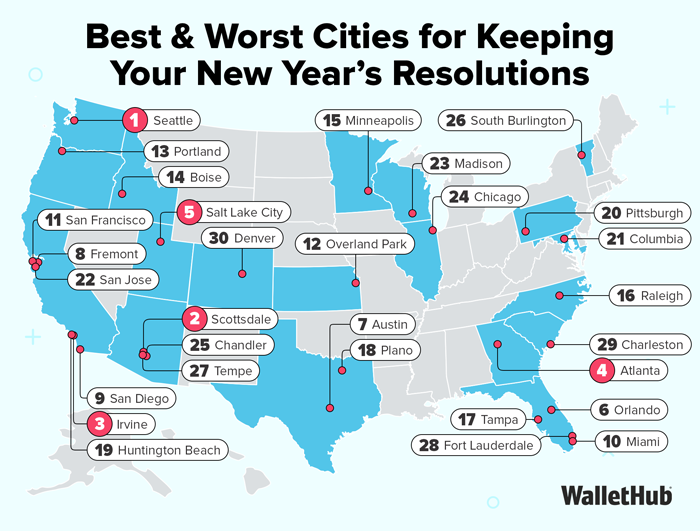
Americans’ top financial resolutions for 2026 are to make a realistic budget and stick to it and save more money and the personal-finance company WalletHub on Jan. 5 released its report on 2026’s Best & Worst Cities for Keeping Your New Year’s Resolutions to help people flourish from January through December. This new report complements WalletHub’s list of the previously released top New Year’s Financial Resolutions for 2026.
Best Cities for Keeping Resolutions
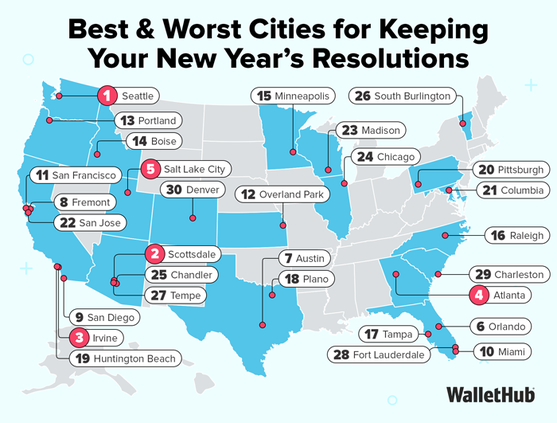
Seattle, Washington was ranked at the top of the list, the best city in the country for keeping resolutions. The rest of the top 10 were: Scottsdale, AZ; Irvine, CA; Atlanta, GA; Salt Lake City, UT; Orlando, FL; Austin, TX; Fremont, CA; San Diego, CA; and at number 10, Miami, Florida. Finishing just outside the top 10 was San Francisco, CA, ranked at number 11.
Worst Cities for Keeping Resolutions
The bottom 10 on the list, from number 173 to number 182, were: Toledo, Ohio at 173; Huntington, WV; Montgomery, AL; Augusta, GA; Newark, NJ; Memphis, TN; Dover, DE; Shreveport, LA; Gulfport, MS and, the last on the list, Jackson, Mississippi.
Best vs. Worst
Fremont, California, has the lowest share of obese adults – 3.4 times lower than in Jackson, Mississippi, the city with the highest.
Sioux Falls and Rapid City, South Dakota, have the lowest unemployment rate – 5.4 times lower than in Detroit, Michigan, the city with the highest.
Fremont, California, has the lowest share of delinquent debtors – 6.9 times lower than in Jackson, Mississippi, the city with the highest.
Birmingham and Montgomery, Alabama, have the lowest prevalence of adult binge drinking – two times lower than in Missoula, Montana, the city with the highest.
Seattle, Washington and Fremont, California, have the lowest share of adult smokers – 3.3 times lower than in Cleveland, Ohio, the city with the highest.
To view the full report, visit:
https://wallethub.com/edu/best-cities-for-new-years-resolutions/28749
“Everyone has probably failed to keep a New Year’s resolution at one point, whether it’s losing weight, spending less money, quitting a vice or keeping up with a new hobby. The pressures of inflation, the busyness of everyday life, and the stress of the current news cycle certainly don’t help. Living in the right city can do wonders for resolutions, though. For example, cities with good access to healthy food and exercise opportunities can make it much easier for people to improve their health. Cities with strong economies and good job markets can expedite finding a better career or improving your income. Finding out what your city excels in can help you set an achievable goal,” said Chip Lupo, WalletHub Analyst. “Seattle is the best city for keeping your New Year’s resolutions, particularly those related to your physical and financial well-being. Seattle has the lowest percentage of physically inactive adults, at less than 13 percent, along with the sixth-lowest obesity rate in the country. In addition, Seattle has the second-lowest percentage of people who are delinquent on their debt payments, and residents have very low levels of debt relative to their incomes. Quitting vices is another common New Year’s resolution, and Seattle has the lowest percentage of adults who smoke daily or on most days.”
Expert Commentary
What tips do you have for people looking to improve their financial habits in the new year?
“Pick one thing you want to improve and focus on that. Create a plan on how you will improve or change your habit. Don’t try to change everything overnight – begin with baby steps to make sure your strategy will work, and be open to changing up your approach if it doesn’t!”
Jonas C. Sheckler – Assistant Director of Financial Wellbeing, Career Center, Towson University
“From a motivational standpoint, the typical advice is to set what are known as ‘SMART’ goals: those that are Specific, Measurable, Attainable, Relevant, and Time-Bound … However, beyond setting goals, there’s another piece to the puzzle: subsequently striving toward achieving those goals. Here, keep in mind that resisting temptation in the moment is much harder than avoiding it altogether through prior planning. If the goal is to avoid spending so that one can instead save, it’s hard to resist an impulse purchase in the moment but easier to plan ahead by limiting one’s own ability to spend impulsively. For instance, a person could automatically have a certain amount of money each month diverted to a second bank account and/or could ask the credit card company to lower their monthly spending limit.
Reeshad S. Dalal, Ph.D. – Professor, George Mason University
What age-appropriate resolutions can help kids build skills and habits that will serve them well into adulthood?
“Learning to be resilient in the face of failure; building your self-efficacy (i.e., your belief in your ability to do a specific task) takes time and learning from mistakes. Being allowed to make mistakes and feel the sting of defeat is necessary for emotional complexity and growth.”
José F. Rodríguez, Ph.D. – Associate Teaching Professor, Florida International University
“I think that depends on age. Elementary students can learn the basics of savings and resolve to save a small part of any money they receive to begin the habit of saving money. Middle schoolers can focus on financial goals, like saving for a hobby item, or spending less on impulse snacks, which teaches the basics of budgeting, personal accountability, and self-directed motivation. For teens, they can commit to creating and following a basic monthly budget even if they only manage small sources of income, like babysitting, allowance, or part-time jobs. This builds confidence with money management and helps them practice real-world financial organization.”
Jonas C. Sheckler – Assistant Director of Financial Wellbeing, Career Center, Towson University
Why do so many people fail to keep their New Year’s resolutions? What can they do to increase their odds of success?
“Building new habits is really difficult! Generally, there are two processes happening when you build a new habit – one process is ‘monitoring’ your behavior for the old, bad habits. The second process is ‘distraction’, where you put effort in to distract yourself from your old behavior and replace it with a new behavior. The problem is that when you feel stressed or distracted, the distraction process goes offline, so often, the bad habits come back even more intensely than they were in the first place. One solution is the habit loop: Cue, Craving, Response, Reward. For example, let’s say you find yourself always making last minute purchases when you’re standing in line at the checkout. The cue is feeling bored in line, so you crave stimulation, which leads you to buy a treat at the last minute to feel better. If we can disrupt this loop, and replace it with a new loop that will help. So maybe I start making sure to keep my hands full while I’m in line to make it harder to grab those impulse items. I can then think of a way to reward myself for keeping the habit, like if I go a week without impulse purchases, I put the money I saved towards something more important to me, like a hobby or some other fun treat.”
Kristie Campana, Ph.D. – Program Director, Minnesota State University
“Most New Year’s resolutions fizzle out within a few weeks of the new year because most people will make either vague resolutions or unrealistic resolutions. For example, making a resolution to lose weight is incredibly vague. One needs to have a more specific plan: how much do you want to lose and by when? What concrete steps will be taken to lose weight (e.g., diet and/or exercise routine). Speaking of an exercise routine, it needs to be realistic; are you really going to go to the gym every day for three hours? I highly doubt it. So, instead, make realistic goals that are simple and attainable: ‘I’ll go to the gym once a week for 30 minutes.”
José F. Rodríguez, Ph.D. – Associate Teaching Professor, Florida International University