With migration patterns in 2025 largely shaped by affordability, opportunity, and quality of life, the personal-finance company WalletHub has released its report on the Best & Worst Places to Raise a Family in 2026, as well as expert commentary, to help people find the best place to put down roots.
Two California cities were in the top 10 on the list while two Mississippi cities were ranked in the bottom 10.
WalletHub compared more than 180 cities across 45 key metrics. The data set ranges from housing affordability to school-system quality to the unemployment rate.
Best Cities for Families
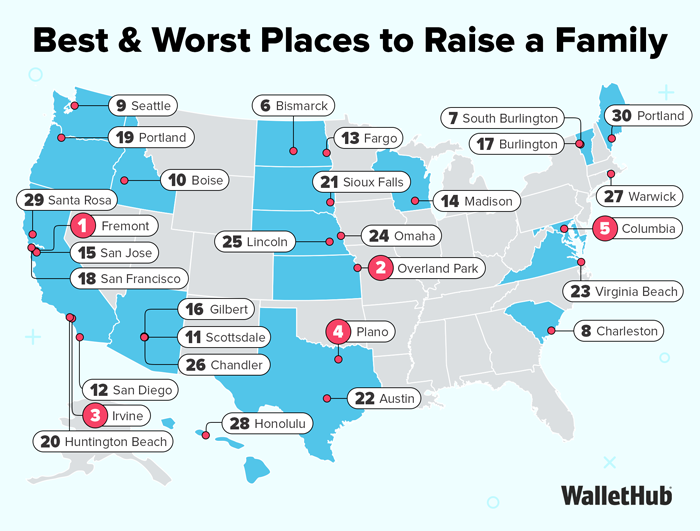
Fremont, California was at the top of the list, rated as the best city in the study for raising a family. Coming in at number two was Overland Park, Kansas, followed by Irvine, CA; Plano, TX; Columbia, MD; Bismarck, ND; South Burlington, VT; Charleston, SC; Seattle, WA; and, rounding out the top 10, Boise Idaho.
Worst Cities for Families
Hialeah, Florida came in at number 173 to kick off the bottom 10, followed by Birmingham, AL; Shreveport, LA; Jackson, MS; Newark, NJ; Baltimore, MD; Gulfport, MS; Cleveland, OH; Memphis, TN; and, at number 182, Detroit, Michigan.
Best vs. Worst
Las Vegas has the most playgrounds (per square root of the population), which is 24.6 times more than in Gilbert, Arizona, the city with the fewest.
Warwick, Rhode Island, has the fewest violent crimes (per 1,000 residents), which is 31.7 times fewer than in Memphis, Tennessee, the city with the most.
Columbia, Maryland, has the highest median family annual income (adjusted for cost of living), which is 3.1 times higher than in Detroit, the city with the lowest.
Scottsdale, Arizona, has the lowest share of families receiving food stamps, which is 21 times lower than in Detroit, the city with the highest.
Overland Park, Kansas, has the lowest share of families living in poverty, which is 7.9 times lower than in Detroit, the city with the highest.
“Finding the best place to raise a family is difficult, between balancing an affordable cost of living with good educational opportunities, safety and enough recreation to keep kids entertained. On top of all of these factors, people also often want to raise their children close to their extended family. Therefore, current or prospective parents can benefit from narrowing down their choices to a few of the best cities that are within a reasonable drive of their family,” explained WalletHub Analyst Chip Lupo, WalletHub Analyst. “Fremont, California, is the best place to raise a family in 2026, with one of the highest median family incomes and the second-lowest share of families living in poverty. Fremont is especially good when it comes to children’s education, with nearly 71% of public schools rated at least a 7 out of 10. In addition, Fremont is a good city for children’s health, as only 1.6% of children lack health insurance and only 1.1% of the population lacks access to healthy food.”
To view the full report, visit:
https://wallethub.com/edu/best-cities-for-families/4435
Expert Commentary
To what degree is child development and a family’s quality of life influenced by the city in which they live? How?
“A child’s development is significantly shaped by their environment, especially in a time where access and exposure are constant and immediate. Living in a city often means a faster-paced environment with greater exposure to diversity across culture, people, and experiences. This can support the development of well-rounded children who are able to engage with and appreciate differences, adapt to change, and take advantage of varied learning opportunities. At the same time, exposure alone is not enough. Guidance, structure, and safety are essential. When families are supported by safe communities and intentional parenting, children can thrive. Ultimately, the environment, available opportunities, and community support all shape a child’s lived and learned experiences.”
April Lancit, LMFT – Assistant Professor, La Salle University
“Where families live matters a great deal. Children don’t develop in a vacuum – instead, everything around them plays a role in shaping them – within their families, schools, neighborhoods, and communities. Research consistently shows that cities shape many of the experiences that influence short- and long-term health and wellbeing. Access to safe neighborhoods, good schools, parks, health care, and economic opportunity all matter. Just as importantly, communities that foster connection and support tend to help families thrive. Chronic stressors like violence, instability, long commutes, and lack of resources have been shown to negatively affect both parents and children over time.”
Jeff Temple, Ph.D. – Professor, UTHealth Houston
How can local officials make their cities more attractive to young families?
“If local officials are serious about supporting young families, they must recognize that policies and environments either strengthen or undermine family life. Communities that provide safe, accessible spaces for families to gather – parks, schools, and community centers – create natural opportunities for shared experiences that deepen connection. At the same time, reducing systemic stressors such as unreliable childcare or excessive commute times allows parents to be more emotionally present in their homes. When cities are structured in ways that promote stability, safety, and interaction, they foster not just residency, but belonging that then facilitates family flourishing.”
Angela Bradford – Associate Professor, Brigham Young University
“Local officials can make cities more attractive by intentionally building family-centered communities. This includes creating safe, vibrant neighborhoods that offer meaningful opportunities for children and families to learn, connect, and engage. A strong community includes accessible public spaces, family-friendly programming, and opportunities for enrichment. When cities invest in environments that promote connection, safety, and growth, families are more likely to see them as places where they can build and sustain their lives.”
April Lancit, LMFT – Assistant Professor, La Salle University
What should families consider when choosing a place to settle down?
“School quality and safety are the most commonly cited factors – and rightly so. But families often underweight a few others that matter just as much over time. Childcare costs and availability can rival housing as a budget line item for families with young children, and access varies enormously by city. Healthcare infrastructure – especially pediatric care – deserves a hard look. Community character is harder to quantify but worth assessing: Are neighbors long-term residents? Are there parks, third places, and opportunities for kids to build friendships organically? Finally, families should stress-test the economics – not just current housing costs, but job market depth, commute times, and cost-of-living trajectory. A city that’s affordable today but trending sharply upward may not be the stable foundation it appears.”
Sampathkumar Ranganathan, Ph.D. – Associate Professor, The University of Wisconsin–Green Bay